
Reiki does not belong to the past nor does it need to be «reinvented» to stand in the present. It is a living energy practice that has been practiced for more than a century and continues to evolve through the conscious experience of those who experience it. Its timelessness is not based on trends or promises, but on the profound simplicity of contact with energy and awareness.
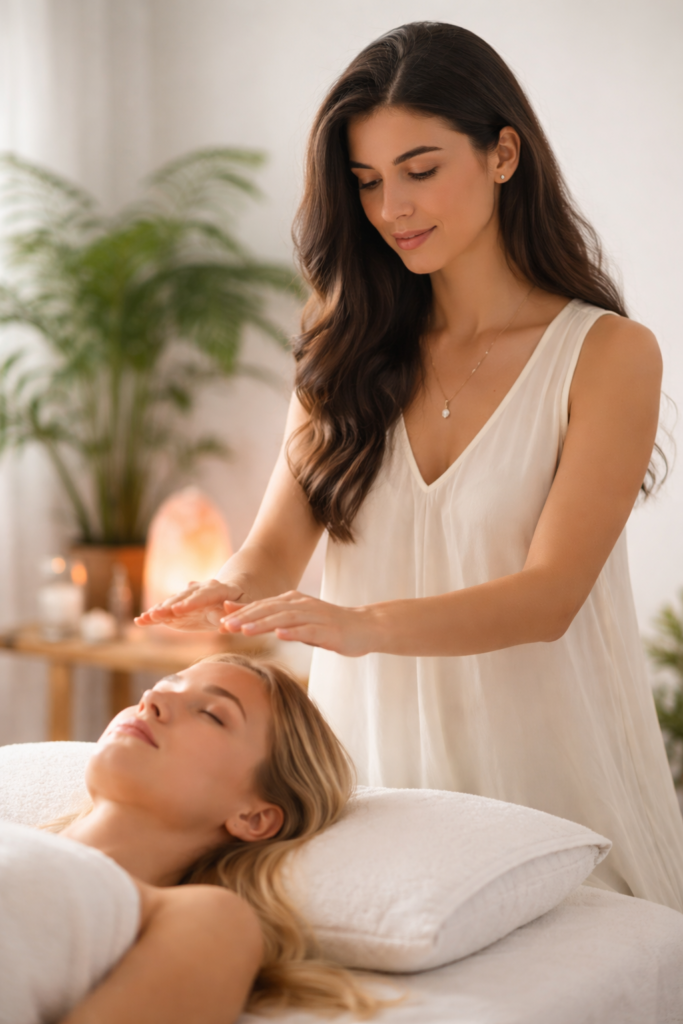
The word Reiki comes from the Japanese ideograms Rei and Ki. Rei refers to the universal, the spiritual realm that permeates everything, while Ki is the vital energy that moves within every living organism. Reiki, as a concept and practice, describes the conscious connection between these two levels: the individual and the universal.
In practice, Reiki works as a method of energy balancing and inner peace. It does not violently interfere, does not «correct» or impose itself on the body or mind. Instead, it creates the conditions for the system to relax, discharge and return to its natural flow. For this reason, many experience it not as a healing in the classical sense, but as a process of deep reconnection with the self.
The modern spread of Reiki begins in the early 20th century in Japan, with Mikao Usui. Usui presented Reiki not as a healing technique, but as a spiritual life exercise, inextricably linked to personal cultivation, moral attitude and conscious presence in everyday life. At the core of his philosophy is the idea that inner balance precedes any external change.
As Reiki traveled outside Japan, mainly to the West, it began to adapt to different cultural contexts. Over the decades, various schools and approaches emerged, sometimes emphasizing the therapeutic dimension, sometimes psychological support, and sometimes a metaphysical interpretation of the energy. This evolution has made Reiki more accessible to a wider audience, but at the same time has, in some cases, moved it away from its original simplicity.
Today, Reiki is practiced all over the world, both on a personal and professional level. It is used as a supplement in times of intense stress, emotional strain or personal transitions, but also as a constant practice of self-observation and inner grounding. What keeps it alive is not its form, but the experience it offers: a calm return to the present.
In the next part of the article we will focus on a more authentic and less altered expression of this practice: the Komio Reiki. We will look at how and why it was created, what philosophy underlies it, who is behind its spread, and what essentially differentiates it from Western versions of Reiki.
And if you feel it's time to experience it in person, you can book your own session by clicking on
I want to change my energy
Komio Reiki: back to the essence and simplicity
Komio Reiki was created as a conscious return to the original Japanese Reiki philosophy. It arose not to «correct» the Western schools, but to remind us of something that had gradually been lost: that Reiki is not a technique for achieving results, but a state of consciousness.
The Komio Reiki school was founded by Hyakuten Inamoto, a Japanese Reiki master, who had studied in various lines and observed that as Reiki spread to the West, it drifted away from its original purpose. He felt that Reiki was «loaded» with too much theory, promises and complex interpretations, when in its essence it was something simple, experiential and directly applicable to everyday life.
The word «Komio» means light. Not light as an impressive or metaphysical concept, but the light of clarity, awareness and clear perception. In Komio Reiki, the emphasis is not on changing something outside of us, but on illuminating what already exists within us. Energy does not «do the work» for us; it acts as a means of observation, acceptance and inner peace.
One of the main characteristics of Komio Reiki is that it remains faithful to the Japanese symbols and the philosophy from which they originated. Symbols are not seen as tools of power or control, but as vehicles of meaning and concentration of intention. According to the Japanese concept, writing, sound and intention are inextricably linked, and therefore the use of original ideograms is considered more consistent both linguistically and energetically.
The mindset of Komio Reiki is deeply practical. It does not require faith, does not ask you to adopt a dogma, and does not promise miracles. Instead, it invites you to notice how your inner state changes when you allow energy to flow without expectation. Through this process, many people report greater calm, clearer thinking, emotional release and a sense of «stepping» more firmly into their lives.
On the level of experience, Reiki - and especially Komio Reiki - often acts as a support in times of transition. When something is ending, when something new is beginning, or when there is confusion and internal blockage, the practice helps to reduce the internal noise. It doesn't give ready answers, but creates space for the right questions to emerge.
In terms of the scientific approach, Reiki has been studied mainly in relation to relaxation, stress reduction and general well-being. There are studies that show positive effects on indicators of stress and subjective well-being, but without positioning it as a substitute for medical care. This, moreover, is consistent with its own philosophy: reiki works complementarily, not competitively.
Ultimately, what makes Komio Reiki stand out is not that it «goes the extra mile», but that it removes what is unnecessary. It sticks to the essence: presence, intention and acceptance. And perhaps that is where its strength lies.
If you feel you want to experience this personally, you can book your own session by clicking on
I want to change my energy
How remote Reiki sessions work
Reiki's distance sessions are based on the same principle that underlies his entire philosophy: energy is not limited by space or time. Intention, when clear and focused, acts as a bridge of connection between the therapist and the person receiving the session.
During a distance session, no physical presence or active participation is required. All that is required is to be in a quiet space and allow yourself to relax. Many people choose to lie down, others simply sit with their eyes closed. There is no «right» or «wrong» way.
The experience varies from person to person. Some feel a deep relaxation, others experience an emotional release, while for many the effect is felt in the following hours or days through more clarity, calmness or a change in mood. Reiki does not impose, but works supportively, following the natural rhythm of each body.
It has been observed that distance sessions are often experienced as highly focused, precisely because external distractions are absent. Energy is directed with intention for the greater good, without expectation or control of the outcome.
In essence, a distance Reiki session is an invitation to stop for a while, to return to your body and your inner silence, and allow what needs to come out naturally.
If you feel you want to experience this personally, you can book your own session by clicking on
I want to change my energy
 Greek
Greek  English